

CHERCHER CE QUE VOUS VOULEZ
Eau de forage dure : Devriez-vous utiliser un adoucisseur d'eau ou un RO?
Temps:2026-09-01
La dureté est un problème courant dans l'eau de forage. Des niveaux élevés de calcium et de magnésium peuvent provoquer des dépôts blancs, des tuyaux bouchés, une efficacité de chauffage réduite et une tartre à l'intérieur des équipements de production.
Les adoucisseurs d'eau et les systèmes d'osmose inverse peuvent contrôler la dureté, mais ils fonctionnent différemment. Un adoucisseur est normalement sélectionné lorsque la prévention du tartre est l'objectif principal, tandis que RO est plus approprié lorsque le projet nécessite également une TDS, une conductivité et des contaminants dissous inférieurs.
Quelles sont les causes de l'eau de forage dure?
Lorsque les eaux souterraines se déplacent dans la roche et le sol souterrains, elles dissolvent le calcium, le magnésium et d'autres minéraux. Le niveau de dureté dépend de la géologie locale, de la profondeur du puits et des conditions saisonnières des eaux souterraines.
Les signes courants d'eau de forage dure comprennent :
- •Échelle blanche sur les réservoirs, les tuyaux et les vannes
- •Blocage fréquent des buses ou des échangeurs de chaleur
- •Réduction de l'efficacité de la chaudière ou du chauffage
- •Savon qui ne mousse pas facilement
- •Taches sur le verre et l'équipement
- •Augmentation de la pression de la membrane RO
- •Nettoyage fréquent de l'équipement
Une analyse complète de l'eau doit être effectuée avant de sélectionner un Système de traitement des eaux de forage.
Comment un adoucisseur d'eau traite-t-il la dureté?
Un adoucisseur d'eau utilise une résine échangeuse d'ions pour remplacer les ions calcium et magnésium par des ions sodium.
Il est principalement utilisé pour :
- •Empêcher l'échelle dans les pipelines
- •Protéger les chaudières et les échangeurs de chaleur
- •Améliorer le lavage et le nettoyage
- •Protéger les membranes RO en aval
- •Réduire la maintenance des équipements
Un adoucissant élimine la dureté mais ne réduit pas significativement le TDS, la conductivité, le chlorure, le sulfate, le nitrate ou d'autres sels dissous.
Choisissez un adoucisseur d'eau lorsque :
- •La dureté est le principal problème de qualité de l'eau
- •Une faible conductivité n'est pas requise
- •L'eau est utilisée pour le lavage, le refroidissement ou l'utilité générale
- •La protection de l'échelle est l'objectif principal
- •La régénération régulière du sel est acceptable
Un bien conçu Système de prétraitement de l'eau peut inclure un adoucisseur automatique, un réservoir de saumure et un contrôle de régénération.
Comment RO traite-t-il l'eau de forage dure?
L'osmose inverse utilise la séparation membranaire pour réduire le calcium, le magnésium et de nombreux autres contaminants dissous.
RO peut réduire :
- •Dureté
- •TDS et conductivité
- •Chlorure et sulfate
- •Nitrate et fluorure
- •Métaux dissous
- •Autres sels minéraux
Choisissez RO Quand :
- •L'eau du produit à faible teneur en TDS est requise
- •L'eau est utilisée pour la boisson ou la production alimentaire
- •Le projet nécessite de l'eau de traitement à conductivité contrôlée
- •L'eau du forage contient plusieurs contaminants dissous
- •La réduction de la dureté seule est insuffisante
- •L'eau alimentera les chaudières ou les équipements de production sensibles
Explorez notre personnalisable Systèmes industriels d'osmose inverse pour différentes conditions d'eau de forage.
Adoucisseur d'eau vs RO
| Article | Adoucisseur d'eau | Osmose inverse |
|---|---|---|
| Fonction principale | Supprime la dureté du calcium et du magnésium | Réduit la dureté et les sels dissous |
| Réduction TDS | Pas de réduction significative | Réduction significative |
| Contrôle de la balance | Efficace | Efficace avec une conception correcte |
| Eaux usées | Les eaux usées de régénération | Eau concentrée |
| Consommables | Sel de régénération | Filtres, membranes et produits chimiques |
| Pression de service | Relativement faible | Plus haut |
| Conductivité produit-eau | Similaire à l'eau d'alimentation | Beaucoup plus bas |
| Meilleure application | Protection contre les balances et eau des services publics | Eau potable et industrielle purifiée |
Le bon choix dépend du besoin final en eau, pas seulement de la dureté.
Avez-vous besoin à la fois d'un adoucissant et d'un RO?
Dans de nombreux projets industriels, la meilleure solution est un adoucisseur d'eau suivi de RO.
Un processus typique est :
Eau de forage → Filtre multimédia → Filtre à charbon actif → Adoucisseur d'eau → Filtre à cartouche → Système RO → Stérilisation UV en option → Réservoir d'eau-produit
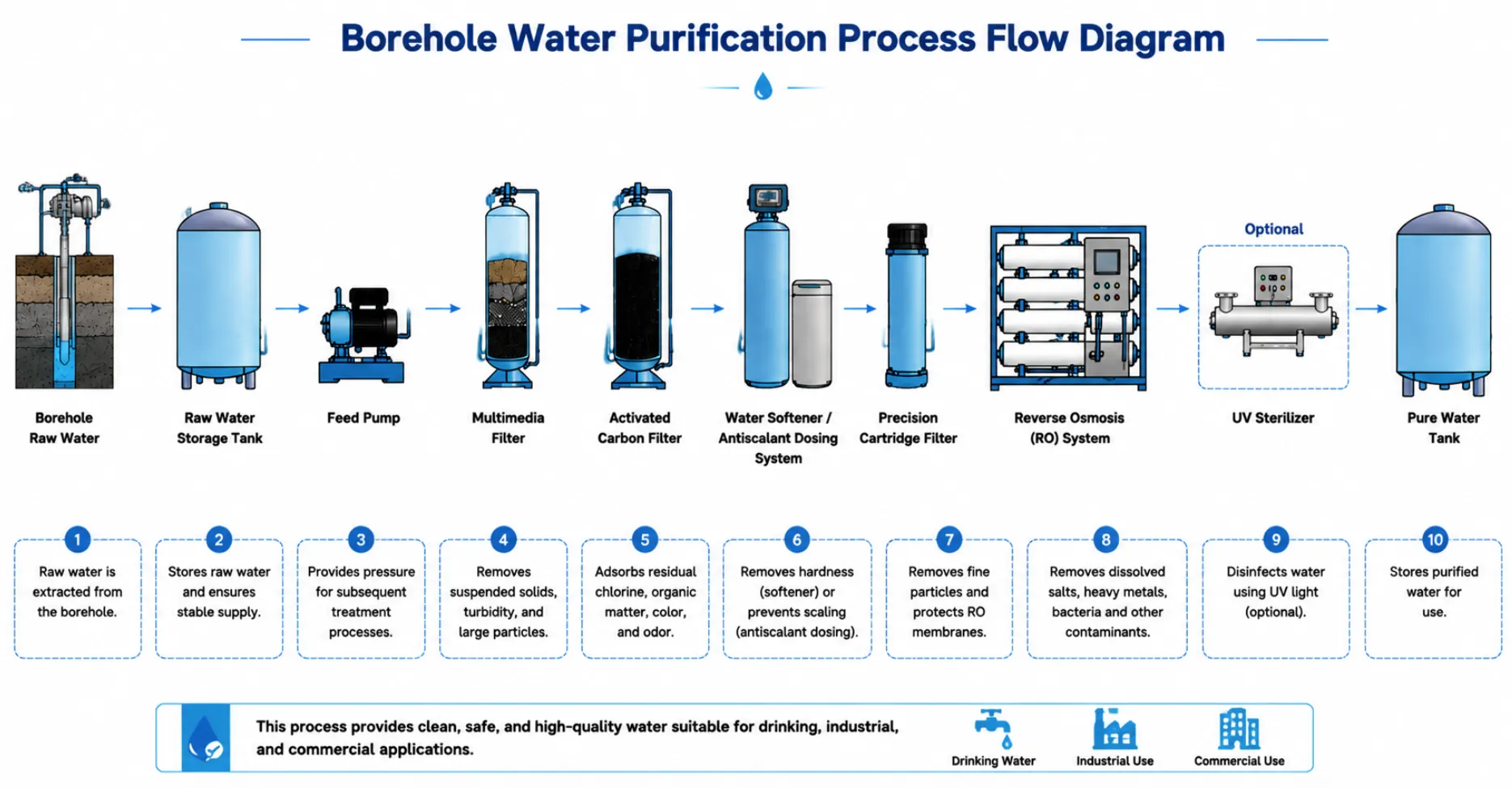
L'adoucissant élimine le calcium et le magnésium avant qu'ils n'atteignent les membranes RO. Cela aide à réduire le risque d'entartrage et permet au système RO de fonctionner de manière plus fiable.
Pour certains projets, un dosage antiscalant peut être utilisé au lieu d'un adoucissement. Le choix dépend de :
- •Dureté et alcalinité de l'eau d'alimentation
- •Concentration en silice
- •Taux de récupération RO
- •Capacité produit-eau
- •Disponibilité des produits chimiques et des sels
- •Wastewater-discharge conditions
- •Coûts d'exploitation et de maintenance
Un adoucissant ou un antidétartrant ne peut pas corriger un taux de récupération RO inapproprié ou une analyse de l'eau incomplète.
Autres problèmes d'eau de forage à vérifier
La dureté n'est peut-être pas le seul problème. L'eau du forage doit également être testée pour :
- •TDS et conductivité
- •Fer et manganèse
- •Silice
- •Nitrate
- •Chlorure et sulfate
- •Turbidité
- •pH
- •Microorganismes
Le fer et le manganèse doivent normalement être éliminés avant le ramollissement ou la RO. En savoir plus sur Comment éliminer le fer et le manganèse de l'eau de forage.
Si du nitrate est présent, consultez notre guide sur Élimination des nitrates de l'eau du puits.
Une teneur élevée en silice nécessite également une récupération et un contrôle de mise à l'échelle spéciaux. En savoir plus sur teneur élevée en silice dans l'eau d'alimentation RO.
Informations requises pour la sélection du système
Pour choisir entre un adoucisseur d'eau et RO, fournissez :
- Analyse complète des eaux de forage
- Capacité produit-eau requise
- Heures d'ouverture quotidiennes
- Application finale d'eau
- Conductivité requise ou norme d'eau
- Espace d'installation disponible
- Tension et fréquence locales
- Wastewater-discharge conditions
Vous pouvez également lire Comment comprendre un rapport sur la qualité de l'eau Avant de demander un devis.
Conclusion
Utilisez un adoucisseur d'eau lorsque la dureté et le tartre sont les principaux problèmes et qu'un faible TDS n'est pas requis. Choisissez l'osmose inverse lorsque l'eau doit également avoir une conductivité, une salinité et des contaminants dissous inférieurs.
Pour l'eau de forage dure contenant de multiples contaminants, l'adoucissement suivi de RO peut fournir la solution la plus stable. Le processus final doit toujours être basé sur une analyse récente de l'eau et l'utilisation prévue de l'eau du produit.
Zhongnuo Water Treatment fournit des systèmes personnalisés d'adoucissement de l'eau de forage et d'osmose inverse. Envoyez-nous votre rapport sur l'eau, la capacité requise, les heures de fonctionnement et l'utilisation de l'eau du produit pour une proposition de traitement appropriée.
Questions fréquemment posées
Un adoucisseur d'eau réduit-il le TDS?
Non. Un adoucissant échange le calcium et le magnésium contre du sodium mais ne réduit pas significativement le total des solides dissous.
RO peut-il éliminer la dureté de l'eau du forage?
Oui. Les membranes RO peuvent réduire considérablement le calcium, le magnésium et d'autres sels dissous.
Chaque système RO a-t-il besoin d'un adoucisseur d'eau?
Non. La décision dépend de la dureté, de l'alcalinité, de la silice, du taux de récupération et de la stratégie antiscalante.
L'eau adoucie est-elle la même que l'eau RO purifiée?
Non. L'eau adoucie a une dureté réduite mais contient toujours la plupart des autres sels dissous. L'eau RO a un TDS et une conductivité beaucoup plus faibles.
Quel est le meilleur pour l'eau potable?
Cela dépend de l'analyse complète de l'eau. RO est généralement plus approprié lorsque l'eau potable contient un TDS élevé ou de multiples contaminants dissous, tandis qu'un adoucisseur ne traite que de la dureté.
La dureté est un problème courant dans l'eau de forage. Des niveaux élevés de calcium et de magnésium peuvent provoquer des dépôts blancs, des tuyaux bouchés, une efficacité de chauffage réduite et une tartre à l'intérieur des équipements de production.
Les adoucisseurs d'eau et les systèmes d'osmose inverse peuvent contrôler la dureté, mais ils fonctionnent différemment. Un adoucisseur est normalement sélectionné lorsque la prévention du tartre est l'objectif principal, tandis que RO est plus approprié lorsque le projet nécessite également une TDS, une conductivité et des contaminants dissous inférieurs.
Quelles sont les causes de l'eau de forage dure?
Lorsque les eaux souterraines se déplacent dans la roche et le sol souterrains, elles dissolvent le calcium, le magnésium et d'autres minéraux. Le niveau de dureté dépend de la géologie locale, de la profondeur du puits et des conditions saisonnières des eaux souterraines.
Les signes courants d'eau de forage dure comprennent :
- •Échelle blanche sur les réservoirs, les tuyaux et les vannes
- •Blocage fréquent des buses ou des échangeurs de chaleur
- •Réduction de l'efficacité de la chaudière ou du chauffage
- •Savon qui ne mousse pas facilement
- •Taches sur le verre et l'équipement
- •Augmentation de la pression de la membrane RO
- •Nettoyage fréquent de l'équipement
Une analyse complète de l'eau doit être effectuée avant de sélectionner un Système de traitement des eaux de forage.
Comment un adoucisseur d'eau traite-t-il la dureté?
Un adoucisseur d'eau utilise une résine échangeuse d'ions pour remplacer les ions calcium et magnésium par des ions sodium.
Il est principalement utilisé pour :
- •Empêcher l'échelle dans les pipelines
- •Protéger les chaudières et les échangeurs de chaleur
- •Améliorer le lavage et le nettoyage
- •Protéger les membranes RO en aval
- •Réduire la maintenance des équipements
Un adoucissant élimine la dureté mais ne réduit pas significativement le TDS, la conductivité, le chlorure, le sulfate, le nitrate ou d'autres sels dissous.
Choisissez un adoucisseur d'eau lorsque :
- •La dureté est le principal problème de qualité de l'eau
- •Une faible conductivité n'est pas requise
- •L'eau est utilisée pour le lavage, le refroidissement ou l'utilité générale
- •La protection de l'échelle est l'objectif principal
- •La régénération régulière du sel est acceptable
Un bien conçu Système de prétraitement de l'eau peut inclure un adoucisseur automatique, un réservoir de saumure et un contrôle de régénération.
Comment RO traite-t-il l'eau de forage dure?
L'osmose inverse utilise la séparation membranaire pour réduire le calcium, le magnésium et de nombreux autres contaminants dissous.
RO peut réduire :
- •Dureté
- •TDS et conductivité
- •Chlorure et sulfate
- •Nitrate et fluorure
- •Métaux dissous
- •Autres sels minéraux
Choisissez RO Quand :
- •L'eau du produit à faible teneur en TDS est requise
- •L'eau est utilisée pour la boisson ou la production alimentaire
- •Le projet nécessite de l'eau de traitement à conductivité contrôlée
- •L'eau du forage contient plusieurs contaminants dissous
- •La réduction de la dureté seule est insuffisante
- •L'eau alimentera les chaudières ou les équipements de production sensibles
Explorez notre personnalisable Systèmes industriels d'osmose inverse pour différentes conditions d'eau de forage.
Adoucisseur d'eau vs RO
| Article | Adoucisseur d'eau | Osmose inverse |
|---|---|---|
| Fonction principale | Supprime la dureté du calcium et du magnésium | Réduit la dureté et les sels dissous |
| Réduction TDS | Pas de réduction significative | Réduction significative |
| Contrôle de la balance | Efficace | Efficace avec une conception correcte |
| Eaux usées | Les eaux usées de régénération | Eau concentrée |
| Consommables | Sel de régénération | Filtres, membranes et produits chimiques |
| Pression de service | Relativement faible | Plus haut |
| Conductivité produit-eau | Similaire à l'eau d'alimentation | Beaucoup plus bas |
| Meilleure application | Protection contre les balances et eau des services publics | Eau potable et industrielle purifiée |
Le bon choix dépend du besoin final en eau, pas seulement de la dureté.
Avez-vous besoin à la fois d'un adoucissant et d'un RO?
Dans de nombreux projets industriels, la meilleure solution est un adoucisseur d'eau suivi de RO.
Un processus typique est :
Eau de forage → Filtre multimédia → Filtre à charbon actif → Adoucisseur d'eau → Filtre à cartouche → Système RO → Stérilisation UV en option → Réservoir d'eau-produit
L'adoucissant élimine le calcium et le magnésium avant qu'ils n'atteignent les membranes RO. Cela aide à réduire le risque d'entartrage et permet au système RO de fonctionner de manière plus fiable.
Pour certains projets, un dosage antiscalant peut être utilisé au lieu d'un adoucissement. Le choix dépend de :
- •Dureté et alcalinité de l'eau d'alimentation
- •Concentration en silice
- •Taux de récupération RO
- •Capacité produit-eau
- •Disponibilité des produits chimiques et des sels
- •Wastewater-discharge conditions
- •Coûts d'exploitation et de maintenance
Un adoucissant ou un antidétartrant ne peut pas corriger un taux de récupération RO inapproprié ou une analyse de l'eau incomplète.
Autres problèmes d'eau de forage à vérifier
La dureté n'est peut-être pas le seul problème. L'eau du forage doit également être testée pour :
- •TDS et conductivité
- •Fer et manganèse
- •Silice
- •Nitrate
- •Chlorure et sulfate
- •Turbidité
- •pH
- •Microorganismes
Le fer et le manganèse doivent normalement être éliminés avant le ramollissement ou la RO. En savoir plus sur Comment éliminer le fer et le manganèse de l'eau de forage.
Si du nitrate est présent, consultez notre guide sur Élimination des nitrates de l'eau du puits.
Une teneur élevée en silice nécessite également une récupération et un contrôle de mise à l'échelle spéciaux. En savoir plus sur teneur élevée en silice dans l'eau d'alimentation RO.
Informations requises pour la sélection du système
Pour choisir entre un adoucisseur d'eau et RO, fournissez :
- Analyse complète des eaux de forage
- Capacité produit-eau requise
- Heures d'ouverture quotidiennes
- Application finale d'eau
- Conductivité requise ou norme d'eau
- Espace d'installation disponible
- Tension et fréquence locales
- Wastewater-discharge conditions
Vous pouvez également lire Comment comprendre un rapport sur la qualité de l'eau Avant de demander un devis.
Conclusion
Utilisez un adoucisseur d'eau lorsque la dureté et le tartre sont les principaux problèmes et qu'un faible TDS n'est pas requis. Choisissez l'osmose inverse lorsque l'eau doit également avoir une conductivité, une salinité et des contaminants dissous inférieurs.
Pour l'eau de forage dure contenant de multiples contaminants, l'adoucissement suivi de RO peut fournir la solution la plus stable. Le processus final doit toujours être basé sur une analyse récente de l'eau et l'utilisation prévue de l'eau du produit.
Zhongnuo Water Treatment fournit des systèmes personnalisés d'adoucissement de l'eau de forage et d'osmose inverse. Envoyez-nous votre rapport sur l'eau, la capacité requise, les heures de fonctionnement et l'utilisation de l'eau du produit pour une proposition de traitement appropriée.
Questions fréquemment posées
Un adoucisseur d'eau réduit-il le TDS?
Non. Un adoucissant échange le calcium et le magnésium contre du sodium mais ne réduit pas significativement le total des solides dissous.
RO peut-il éliminer la dureté de l'eau du forage?
Oui. Les membranes RO peuvent réduire considérablement le calcium, le magnésium et d'autres sels dissous.
Chaque système RO a-t-il besoin d'un adoucisseur d'eau?
Non. La décision dépend de la dureté, de l'alcalinité, de la silice, du taux de récupération et de la stratégie antiscalante.
L'eau adoucie est-elle la même que l'eau RO purifiée?
Non. L'eau adoucie a une dureté réduite mais contient toujours la plupart des autres sels dissous. L'eau RO a un TDS et une conductivité beaucoup plus faibles.
Quel est le meilleur pour l'eau potable?
Cela dépend de l'analyse complète de l'eau. RO est généralement plus approprié lorsque l'eau potable contient un TDS élevé ou de multiples contaminants dissous, tandis qu'un adoucisseur ne traite que de la dureté.


MESSAGE EN LIGNE
© 2026 Zhongnuo Water Treatment Co., Ltd.